
Fel d 1 Programme
A cat-allergen
blocker in wet food.
An anti-allergenic wet food powered by proteins engineered for retort stability.
Cat allergy affects roughly 10–20% of the global population. The culprit is Fel d 1, a small secretoglobin produced mainly in cat saliva. Our binder is designed to neutralise Fel d 1 inside the cat's mouth, delivered through food pets already love.
i Why wet food matters
The format gap
in pet allergy management.
Wet food represents over 40% of the global cat food market and is growing faster than dry. Many cats prefer or require wet formats for hydration, palatability, or medical reasons.
Yet no existing anti-Fel d 1 product works in wet food. Most rely on IgY antibodies — large proteins that bind allergens to neutralise them. But IgY cannot survive pasteurisation, acidic sauces, and retort sterilisation. This leaves millions of cat owners and their allergic family members without a functional option.
This is the problem Affineo's platform was built to solve: evolving proteins that refuse to break down. Our small binders can lock onto Fel d 1 and are designed to endure what IgY cannot, surviving wet food production with their neutralising power intact.
- Dry kibble only
- Heat-sensitive
- Degrades in acidic formulations
- Large (~160 kDa) — limited diffusion
- Proven concept in dry format
- Wet & dry compatible
- Immunity to pasteurisation & retort
- Stability in acidic formats
- Small binders (~5–15 kDa) — easy epitope access
- GI-transit tolerance*
ii Our approach
Neutralise Fel d 1
where it starts.
We're working towards a simple fix: a small, safe protein added directly to everyday wet food that will block Fel d 1 at the source. No diet changes. No hassle.
Durability by design
Our binders are selected inside a thermophilic host. Only variants that fold and function under extreme conditions pass selection — durability is built in, not bolted on.
Formulation without limits
Unlike IgY antibodies, our approach targets proteins that resist retort sterilisation (≈120 °C) and acidic gravies and sauces. This unlocks formulation in any liquid food format.
Control at source
Our binders are positioned to capture Fel d 1 in the mouth — intercepting the allergen at its primary production site.
iii The target
Fel d 1
up close.
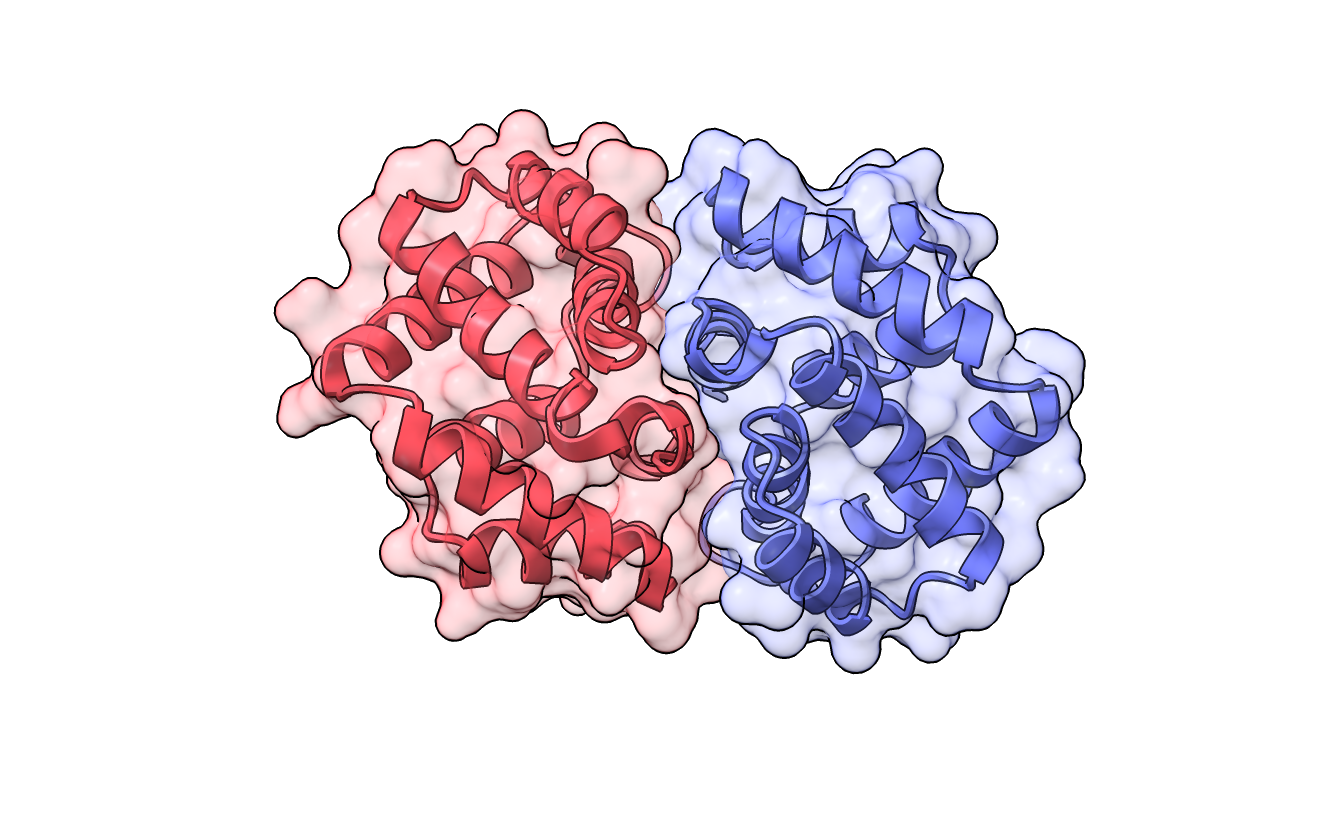
Fel d 1 is a tetrameric glycoprotein (~35 kDa) composed of two symmetrical heterodimers, shown here in red and blue. Each heterodimer is formed by chain 1 and chain 2, linked by three disulphide bonds. The protein belongs to the secretoglobin superfamily.
It is the dominant allergen in cats, responsible for approximately 95% of human allergic reactions to cats. Produced primarily in the salivary and sebaceous glands, it is deposited onto fur during grooming, dries, and becomes airborne on microscopic skin flakes.
We are selecting variants that target conserved epitopes on Fel d 1, preventing the IgE-mediated allergic cascade in sensitised individuals.
Feed the cat.
Reduce the allergen.
No changes to the owner's routine. Just everyday wet food, now with allergen control — made possible by proteins built to endure.